
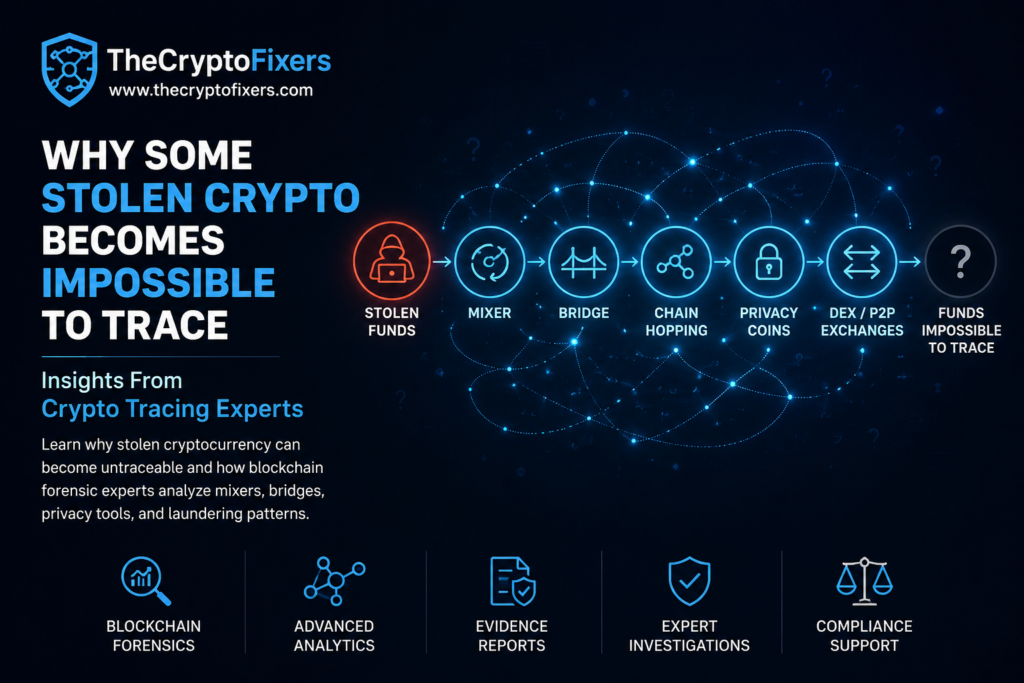
Learn why some stolen cryptocurrency becomes difficult or impossible to trace, how blockchain forensic investigations work, and how crypto tracing experts analyze mixers, bridges, privacy tools, and laundering patterns.
Cryptocurrency transactions are often described as “fully traceable.” While blockchain transparency has transformed digital investigations and made many fraud cases easier to analyze, the reality is far more complex. In some situations, stolen funds can become extremely difficult and sometimes practically impossible to trace with confidence.
This is one of the most misunderstood aspects of blockchain forensics.
Many online recovery services promote unrealistic promises, claiming they can recover or trace any transaction regardless of the circumstances. Experienced crypto tracing experts understand that blockchain investigations depend on evidence quality, transaction timing, laundering methods, exchange cooperation, jurisdictional limitations, and the technical sophistication of the individuals behind the movement of funds.
At TheCryptoFixers, blockchain forensic analysts focus on evidence-driven cryptocurrency tracing, wallet analysis, laundering pattern detection, and transaction intelligence rather than misleading guarantees. Understanding why some funds become difficult to trace helps victims, investigators, and compliance teams develop realistic expectations while improving the quality of forensic investigations.
Understanding Blockchain Traceability
Public blockchains like Bitcoin and Ethereum were designed to provide transparent transaction records. Every transfer is permanently recorded on a distributed ledger visible to anyone with access to a blockchain explorer.
This transparency allows crypto tracing experts to:
- analyze wallet behavior,
- map transaction flows,
- identify exchange interactions,
- detect laundering patterns,
- correlate wallet clusters,
- investigate suspicious activity.
In simple cases, tracing can be straightforward. For example, if stolen funds move directly from one wallet to a centralized exchange account, investigators may be able to document the movement clearly and produce forensic evidence for compliance review.
However, sophisticated laundering methods can rapidly complicate investigations.
Why Blockchain Forensics Is Not Always Straightforward
One of the biggest misconceptions in cryptocurrency investigations is the belief that “all crypto is always traceable.”
Technically, transactions may remain visible forever. But visibility alone does not automatically produce attribution or recovery.
A wallet address does not contain:
- a name,
- passport,
- physical address,
- identity record,
- ownership certificate.
Crypto tracing experts rely on probabilistic analysis, behavioral heuristics, exchange cooperation, forensic intelligence, and blockchain analytics to connect transactions to real-world entities.
When criminals intentionally attempt to obscure their transaction history, the difficulty of attribution increases dramatically.
The Difference Between Visible and Actionable Tracing
A transaction may still be visible on-chain while becoming operationally useless from an investigative perspective.
This distinction matters.
There are three major levels of blockchain visibility:
1. Visible and Attributable
Funds can be traced and linked to identifiable services, exchanges, or wallets.
2. Visible but Obfuscated
Transactions remain public but are heavily mixed, fragmented, or routed through multiple systems.
3. Visible but Operationally Unrecoverable
Funds can technically be seen but cannot realistically be tied to a recoverable endpoint.
Understanding this distinction is central to professional blockchain forensics.
Why Some Stolen Crypto Becomes Difficult to Trace
1. Mixing Services and Tumblers
Cryptocurrency mixers are among the most common tools used to obscure transaction origins.
Mixers combine funds from multiple users and redistribute them in ways designed to break transactional links between incoming and outgoing assets.
This creates major forensic complications.
How Mixers Work
A simplified laundering flow may look like this:
- Stolen funds enter the mixer.
- Assets are pooled with other transactions.
- Funds are redistributed in fragmented amounts.
- Output wallets receive assets disconnected from the original flow.
This process disrupts direct transaction tracing.
Modern crypto tracing experts use:
- clustering heuristics,
- timing analysis,
- transaction pattern correlation,
- probabilistic modeling,
- wallet behavior analysis
to identify potential links despite obfuscation.
However, confidence levels may decrease significantly after sophisticated mixing activity.
2. Cross-Chain Bridges
Cross-chain bridges allow assets to move between different blockchains.
For example:
- Ethereum to BNB Chain,
- Bitcoin to wrapped assets,
- Solana to Ethereum ecosystems.
Each bridge transition creates additional investigative complexity.
Why Bridges Complicate Tracing
Different blockchains:
- use different architectures,
- maintain separate datasets,
- support different privacy tools,
- require different analytics methodologies.
Attackers may repeatedly bridge funds across ecosystems to:
- fragment investigative trails,
- exploit analytics gaps,
- increase tracing costs,
- delay investigations.
Crypto tracing experts often need multi-chain analysis frameworks to reconstruct movement patterns across fragmented ecosystems.
3. Chain Hopping
Chain hopping refers to rapidly moving assets across multiple cryptocurrencies or networks.
Example:
- ETH → stablecoin → privacy coin → wrapped token → decentralized exchange → another blockchain.
This process:
- increases transaction volume,
- multiplies wallet addresses,
- complicates attribution,
- creates fragmented data points.
Sophisticated laundering operations may involve hundreds or thousands of transactions executed within hours.
4. Privacy Coins
Privacy-focused cryptocurrencies create one of the most difficult environments for blockchain forensic investigations.
Unlike transparent blockchains, privacy coins intentionally obscure:
- sender identities,
- receiver identities,
- transaction amounts.
Examples of privacy-enhancing technologies include:
- ring signatures,
- stealth addresses,
- confidential transactions.
Why Privacy Coins Matter
When stolen assets are converted into privacy-focused ecosystems, tracing visibility may decrease dramatically.
In some scenarios:
- investigators can confirm funds entered a privacy system,
- but cannot confidently determine subsequent movement paths.
This creates a major operational challenge.
5. Decentralized Exchanges (DEXs)
Decentralized exchanges allow users to trade assets without centralized custodians.
Unlike regulated exchanges, DEX platforms often:
- require no KYC,
- permit rapid swapping,
- support permissionless access,
- enable anonymous liquidity movement.
This makes attribution harder.
Crypto tracing experts must analyze:
- swap timing,
- liquidity pool interactions,
- smart contract behavior,
- wallet reuse patterns,
- transaction sequencing.
6. Wallet Fragmentation
Criminals frequently split stolen funds into hundreds of smaller wallets.
This technique:
- increases analytical workload,
- creates noisy datasets,
- complicates clustering,
- delays attribution.
Some laundering operations use automated scripts that fragment assets within minutes of theft.
The goal is psychological and technical exhaustion.
7. Delayed Movement Patterns
Not all attackers move funds immediately.
Some stolen assets remain dormant for:
- months,
- years,
- multiple market cycles.
Dormancy complicates investigations because:
- data becomes stale,
- exchange records may expire,
- intelligence value decreases,
- operational leads disappear.
However, dormant wallets sometimes become active again unexpectedly, creating renewed investigative opportunities.
8. Jurisdictional Challenges
Even when tracing identifies destination exchanges, recovery efforts may face:
- regulatory barriers,
- legal limitations,
- international jurisdiction conflicts,
- compliance restrictions.
Some exchanges operate in regions with limited cooperation frameworks.
This creates a gap between technical tracing and operational enforcement.
9. Off-Chain Transactions
Not all crypto activity remains visible on-chain.
Some movement occurs through:
- internal exchange ledgers,
- OTC trading,
- private transfers,
- custodial systems.
Once funds enter off-chain environments, visibility may depend entirely on exchange cooperation.
Without compliance engagement, tracing may reach a dead end.
10. Sophisticated Laundering Networks
Advanced laundering groups may combine:
- mixers,
- bridges,
- decentralized exchanges,
- automated scripts,
- privacy tools,
- multi-chain fragmentation.
These layered techniques create highly complex forensic environments.
Professional crypto tracing experts rely on:
- transaction intelligence,
- wallet clustering,
- behavioral analysis,
- exchange attribution,
- risk-scoring systems,
- cross-chain analytics
to reconstruct probable movement paths.
The Role of Blockchain Analytics in Modern Investigations
Blockchain analytics platforms have significantly improved the capabilities of crypto tracing experts.
Modern forensic systems can:
- identify known exchange wallets,
- detect suspicious patterns,
- analyze transaction networks,
- score wallet risk levels,
- map laundering flows.
However, analytics tools are not magic solutions.
Successful investigations still depend on:
- analyst expertise,
- evidence quality,
- timing,
- investigative methodology,
- exchange cooperation.
Why Timing Matters in Crypto Tracing
The first hours after a theft are often critical.
Rapid movement patterns can:
- fragment assets,
- reduce visibility,
- increase laundering complexity.
Early forensic analysis helps:
- preserve evidence,
- document transaction paths,
- identify initial wallet interactions,
- detect exchange exposure.
The longer an investigation is delayed, the greater the probability that funds will become operationally difficult to trace.
Common Myths About Crypto Tracing
Myth 1: All Crypto Can Be Instantly Recovered
False.
Tracing and recovery are not the same thing.
Tracing identifies transaction movement. Recovery depends on:
- legal processes,
- compliance cooperation,
- jurisdiction,
- timing,
- evidence quality.
Myth 2: Hackers Can “Reverse” Blockchain Transactions
False.
Blockchain transactions are generally irreversible.
No legitimate crypto tracing experts can simply “undo” confirmed blockchain transfers.
Myth 3: Blockchain Is Completely Anonymous
False.
Most public blockchains are pseudonymous, not anonymous.
Wallet activity remains publicly visible.
Myth 4: Mixers Make Funds Completely Invisible
Not entirely.
Mixers complicate investigations significantly, but advanced analytics may still identify patterns under certain circumstances.
How Professional Crypto Tracing Experts Approach Investigations
At TheCryptoFixers, blockchain forensic analysis focuses on structured investigative methodology rather than unrealistic recovery claims.
A professional investigation may include:
Transaction Mapping
Analyzing wallet-to-wallet movement patterns.
Wallet Clustering
Identifying related wallet groups through behavioral analysis.
Exchange Attribution
Detecting interactions with custodial platforms.
Cross-Chain Analysis
Tracking movement across blockchain ecosystems.
Risk Intelligence
Evaluating suspicious wallet activity.
Evidence Documentation
Producing structured forensic reports.
The Importance of Realistic Expectations
One of the most important responsibilities of ethical crypto tracing experts is setting realistic expectations.
Not every case results in:
- identifiable suspects,
- exchange freezes,
- asset recovery,
- actionable leads.
Professional blockchain forensics focuses on:
- evidence integrity,
- investigative transparency,
- accurate analysis,
- documented findings.
This distinction separates legitimate forensic analysis from misleading “guaranteed recovery” marketing.
What Victims Should Do Immediately After a Crypto Scam
1. Preserve Evidence
Save:
- wallet addresses,
- screenshots,
- emails,
- chat logs,
- transaction hashes.
2. Stop Sending Additional Funds
Recovery scams frequently target previous victims.
3. Document Timeline Events
Create a clear chronology of events.
4. Contact Relevant Exchanges
If funds reached exchanges, immediate reporting may help preserve investigative opportunities.
5. Seek Professional Blockchain Analysis
Structured forensic review improves evidence quality.
Red Flags of Fake Crypto Recovery Services
Victims should be cautious of services claiming:
- guaranteed recovery,
- instant recovery,
- “ethical hacking” access,
- blockchain reversal abilities,
- secret recovery methods.
Legitimate crypto tracing experts emphasize:
- forensic analysis,
- evidence documentation,
- investigative transparency,
- realistic limitations.
The Future of Blockchain Forensics
The blockchain investigation industry continues evolving rapidly.
Emerging trends include:
- AI-assisted transaction analysis,
- cross-chain intelligence systems,
- improved wallet attribution,
- behavioral analytics,
- DeFi forensic tooling,
- enhanced compliance collaboration.
At the same time, laundering techniques are also becoming more sophisticated.
This creates an ongoing technological arms race between forensic investigators and criminal networks.
Why Experience Matters in Blockchain Investigations
Blockchain investigations require more than simply reading transaction histories.
Effective crypto tracing experts must understand:
- blockchain architecture,
- wallet behavior,
- exchange systems,
- laundering methodologies,
- compliance workflows,
- forensic documentation standards.
Technical knowledge alone is not enough. Investigative discipline and analytical methodology are equally important.
Work With Experienced Crypto Tracing Experts
If you need professional blockchain forensic analysis, transaction tracing, or investigative support, TheCryptoFixers provides structured crypto tracing and blockchain investigation services designed to support evidence-based analysis.
Our Services Include:
- blockchain forensic investigations,
- wallet tracing,
- transaction analysis,
- scam movement analysis,
- exchange exposure identification,
- cross-chain transaction review,
- forensic reporting support.
Why Clients Choose TheCryptoFixers
- evidence-focused investigations,
- transparent methodology,
- realistic assessments,
- blockchain analytics expertise,
- structured forensic reporting.
Final Thoughts
Blockchain transparency has transformed digital investigations, but tracing stolen cryptocurrency is not always simple.
Sophisticated laundering techniques, privacy tools, chain hopping, fragmented wallets, and jurisdictional limitations can make some stolen assets extremely difficult to trace operationally.
Understanding these realities helps distinguish legitimate blockchain forensic analysis from unrealistic recovery marketing.
Professional crypto tracing experts focus on:
- evidence,
- methodology,
- transparency,
- structured investigation,
- realistic expectations.
As blockchain ecosystems continue evolving, forensic expertise will remain essential in helping victims, compliance teams, and investigators understand how digital asset movement occurs across increasingly complex financial networks.