Learn how to recover stolen crypto from romance scams and social engineering fraud. Discover how TheCryptoFixers, a digital asset investigator, traces blockchain transactions and analyzes scam-related crypto movement.
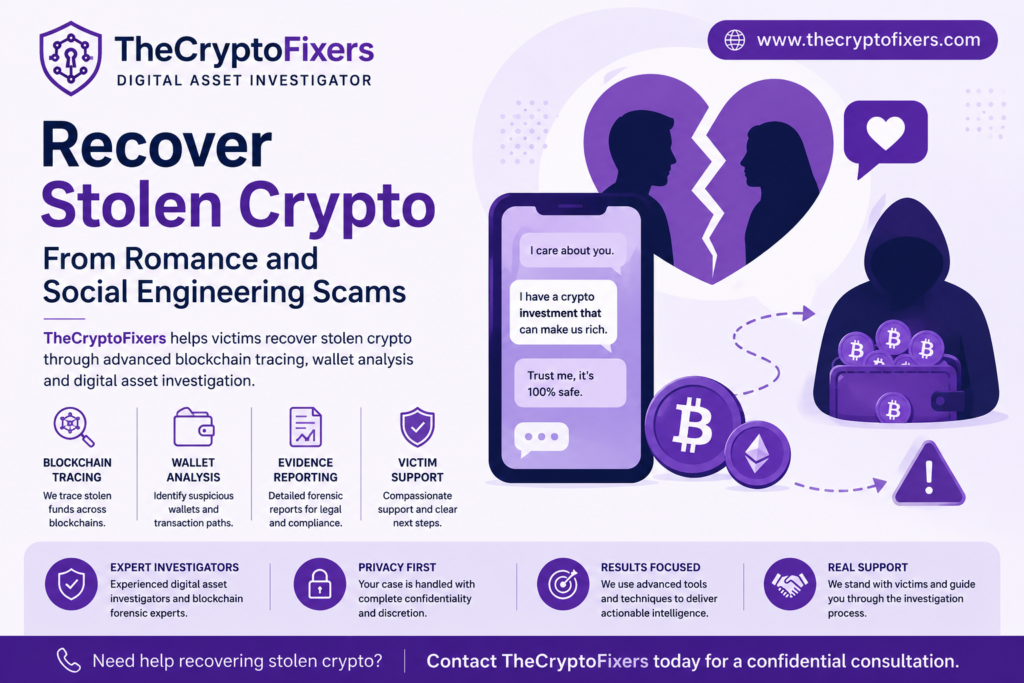
Cryptocurrency scams have evolved dramatically over the last several years. What once consisted primarily of fake emails and phishing attempts has transformed into highly organized social engineering operations capable of manipulating victims emotionally, psychologically, and financially.
Today, one of the fastest-growing forms of cryptocurrency fraud involves romance scams and social engineering scams designed specifically to steal digital assets from unsuspecting individuals.
Victims searching online to recover stolen crypto often describe the same painful experience:
- emotional manipulation,
- fake relationships,
- trust-building conversations,
- fraudulent investment opportunities,
- fake crypto platforms,
- disappearing funds,
- blocked communication,
- devastating financial loss.
Many victims do not realize they are being manipulated until their cryptocurrency has already been transferred across multiple wallets, exchanges, and blockchain networks.
At TheCryptoFixers, digital asset investigators analyze blockchain movement, trace suspicious wallet activity, investigate scam transaction flows, and provide evidence-based blockchain forensic analysis for victims attempting to recover stolen crypto from romance scams and social engineering attacks.
This guide explains:
- how romance crypto scams work,
- how social engineering criminals manipulate victims,
- how stolen cryptocurrency moves across blockchain networks,
- how digital asset investigators trace transactions,
- what victims should do immediately,
- and how blockchain forensic investigations support crypto tracing efforts.
What Is a Romance Crypto Scam?
A romance crypto scam is a type of social engineering fraud where scammers build emotional trust with victims before persuading them to transfer cryptocurrency into fraudulent investment platforms, fake wallets, or scam-controlled addresses.
These scams often begin on:
- dating apps,
- social media,
- messaging platforms,
- professional networking websites,
- online communities.
The scammer may spend:
- weeks,
- months,
- or even longer
building trust before introducing cryptocurrency investment opportunities.
The ultimate goal is to steal digital assets through emotional manipulation.
Victims searching to recover stolen crypto after romance scams often describe feeling:
- embarrassed,
- emotionally devastated,
- financially overwhelmed,
- confused about blockchain transactions,
- unsure where to seek legitimate help.
Why Romance and Social Engineering Scams Are So Effective
Social engineering scams exploit human psychology rather than technical vulnerabilities.
Scammers manipulate:
- trust,
- fear,
- loneliness,
- urgency,
- greed,
- emotional attachment.
These operations are often highly organized and scripted.
Some fraud networks maintain teams responsible for:
- emotional manipulation,
- fake trading dashboards,
- wallet laundering,
- customer impersonation,
- transaction movement,
- communication management.
Victims attempting to recover stolen crypto frequently discover that the scammers:
- used fake identities,
- stole profile photos,
- created fabricated business stories,
- used fraudulent investment dashboards,
- manipulated transaction histories,
- impersonated financial professionals.
The Rise of Crypto Romance Scams
Romance scams involving cryptocurrency have increased globally because:
- cryptocurrency transfers are irreversible,
- blockchain transactions can move across borders instantly,
- scammers exploit decentralized systems,
- victims often lack blockchain knowledge,
- digital assets can be fragmented rapidly.
These scams frequently involve:
- Bitcoin,
- Ethereum,
- stablecoins,
- DeFi platforms,
- fake exchanges,
- decentralized wallets.
Many victims searching to recover stolen crypto do not initially realize their funds were never invested at all.
Instead, funds were routed directly into scam-controlled wallets and laundered across blockchain ecosystems.
Common Stages of Romance Crypto Scams
Stage 1: Initial Contact
Scammers initiate contact through:
- dating apps,
- Instagram,
- Facebook,
- LinkedIn,
- WhatsApp,
- Telegram.
The conversation initially appears normal and personal.
Stage 2: Emotional Trust Building
The scammer spends time building rapport and emotional attachment.
Common tactics include:
- daily conversations,
- fake photos,
- emotional stories,
- promises of future meetings,
- displays of affection,
- fabricated financial success.
Stage 3: Investment Introduction
Eventually, cryptocurrency discussions begin.
The scammer may claim:
- they trade professionally,
- they know “inside opportunities,”
- they have access to profitable platforms,
- they can teach crypto investing.
Stage 4: Fake Platform Exposure
Victims are directed to:
- fake exchanges,
- fraudulent investment dashboards,
- scam trading websites,
- manipulated wallet applications.
These platforms often display fake profits to encourage larger deposits.
Stage 5: Increasing Deposits
Victims are pressured to:
- invest more,
- unlock withdrawals,
- pay taxes,
- pay fees,
- verify accounts.
Each payment request is designed to extract more cryptocurrency.
Stage 6: Disappearance
Eventually:
- withdrawals fail,
- communication stops,
- accounts disappear,
- platforms vanish,
- funds are moved through laundering networks.
Victims then begin searching online to recover stolen crypto.
Why Recovering Stolen Crypto Is Complex
Many victims assume blockchain transparency means recovery is automatic.
Unfortunately, recovering stolen crypto is far more complicated.
While blockchain transactions remain publicly visible, scammers often use:
- mixers,
- decentralized exchanges,
- chain hopping,
- wallet fragmentation,
- privacy tools,
- cross-chain bridges.
These techniques complicate tracing efforts significantly.
How Digital Asset Investigators Trace Stolen Crypto
At TheCryptoFixers, digital asset investigators use structured blockchain forensic methodologies to analyze suspicious cryptocurrency movement.
The investigative process focuses on:
- wallet tracing,
- transaction analysis,
- laundering pattern detection,
- blockchain intelligence,
- exchange exposure identification.
Step 1: Collecting Evidence
The first step to recover stolen crypto involves preserving evidence.
Useful evidence includes:
- wallet addresses,
- transaction hashes,
- screenshots,
- exchange records,
- scam communications,
- payment confirmations,
- emails,
- usernames.
The quality of evidence directly affects investigative visibility.
Step 2: Transaction Mapping
Digital asset investigators map transaction movement across blockchain networks.
This involves analyzing:
- source wallets,
- destination wallets,
- intermediary addresses,
- timing sequences,
- transaction velocity,
- asset conversions.
The goal is to reconstruct how stolen cryptocurrency moved after leaving the victim’s wallet.
Step 3: Wallet Clustering Analysis
Scammers rarely use only one wallet.
Digital asset investigators analyze behavioral patterns to determine whether multiple wallets may belong to related entities.
This process involves:
- transaction timing,
- movement structure,
- address reuse,
- interaction patterns,
- withdrawal behaviors.
Wallet clustering helps investigators understand laundering structures.
Step 4: Exchange Exposure Identification
One of the most important objectives when attempting to recover stolen crypto is identifying interactions with centralized exchanges.
Why?
Because regulated exchanges may maintain:
- KYC information,
- login records,
- IP addresses,
- withdrawal histories,
- compliance documentation.
If stolen funds interact with regulated platforms, investigative opportunities may improve.
Step 5: Cross-Chain Tracing
Modern scam networks frequently move funds across multiple blockchain ecosystems.
Examples include:
- Ethereum,
- Tron,
- BNB Chain,
- Bitcoin,
- Solana,
- Polygon.
Cross-chain tracing helps investigators reconstruct fragmented movement patterns.
Why Scammers Use Multiple Wallets
Scammers attempting to avoid detection often:
- split funds across hundreds of wallets,
- move assets rapidly,
- convert tokens repeatedly,
- use decentralized swaps,
- fragment transaction flows.
The purpose is to:
- increase investigative complexity,
- reduce attribution confidence,
- delay tracing efforts,
- overwhelm victims.
How Mixers Complicate Efforts to Recover Stolen Crypto
Cryptocurrency mixers pool funds from multiple users and redistribute them in ways designed to obscure transactional links.
This creates forensic complications.
Digital asset investigators may still identify:
- timing correlations,
- behavioral patterns,
- wallet interactions,
- probabilistic movement paths.
However, sophisticated mixing activity reduces tracing confidence significantly.
Social Engineering Scams Are Psychological Operations
Many victims searching to recover stolen crypto blame themselves unfairly.
The reality is that organized social engineering scams are designed specifically to manipulate human behavior.
Scammers use:
- emotional dependency,
- urgency,
- trust exploitation,
- authority impersonation,
- fake success stories,
- psychological pressure.
Understanding this helps victims recognize that these scams are calculated criminal operations.
Why Victims Delay Reporting
Victims often wait too long before seeking help because of:
- embarrassment,
- emotional trauma,
- denial,
- fear of judgment,
- confusion about blockchain systems.
Unfortunately, delays can complicate efforts to recover stolen crypto because funds may:
- move across chains,
- enter mixers,
- fragment across wallets,
- disappear into privacy ecosystems.
What Victims Should Do Immediately
1. Stop Sending More Cryptocurrency
Many scammers continue requesting:
- taxes,
- withdrawal fees,
- verification payments,
- recovery fees.
These are usually additional fraud attempts.
2. Preserve Evidence
Save:
- wallet addresses,
- transaction hashes,
- screenshots,
- chat logs,
- exchange records,
- email communication.
3. Document Timeline Events
Create a detailed chronology including:
- initial contact,
- investment discussions,
- transfer dates,
- wallet interactions,
- withdrawal attempts.
4. Seek Blockchain Forensic Analysis
Professional transaction analysis may help identify:
- laundering patterns,
- exchange exposure,
- suspicious wallet activity,
- transaction flow structures.
How TheCryptoFixers Helps Analyze Scam-Related Crypto Movement
At TheCryptoFixers, digital asset investigators focus on:
- blockchain tracing,
- wallet analysis,
- transaction intelligence,
- forensic reporting,
- cross-chain investigation,
- scam transaction analysis.
The goal is to provide evidence-based blockchain forensic support rather than unrealistic guarantees.
Common Wallet Laundering Techniques Used in Romance Scams
Chain Hopping
Funds are moved across multiple blockchains rapidly.
Wallet Fragmentation
Assets are split into numerous smaller wallets.
Stablecoin Conversions
Scammers convert volatile assets into stablecoins for easier movement.
Decentralized Exchange Swaps
DEX platforms enable rapid token swapping without centralized oversight.
Privacy Coins
Privacy-focused cryptocurrencies reduce blockchain visibility.
Why Blockchain Investigations Require Expertise
Blockchain investigations involve:
- forensic methodology,
- transaction intelligence,
- wallet behavior analysis,
- cross-chain analytics,
- exchange attribution,
- laundering detection.
Digital asset investigators combine:
- technical analysis,
- investigative reasoning,
- blockchain intelligence,
- forensic documentation.
Can All Stolen Crypto Be Recovered?
No legitimate investigator can guarantee recovery.
This is important.
Blockchain tracing and recovery are different processes.
Investigators may identify:
- transaction flows,
- exchange exposure,
- suspicious wallet networks,
- laundering methodologies.
However, actual recovery depends on:
- exchange cooperation,
- legal processes,
- jurisdiction,
- timing,
- available evidence.
Ethical digital asset investigators focus on transparency and realistic assessments.
Why Some Victims Become Targets Again
Many victims searching online to recover stolen crypto are approached by fraudulent “recovery agents.”
These scams often claim:
- guaranteed recovery,
- hacking services,
- secret blockchain access,
- instant retrieval.
Victims should remain cautious.
Legitimate digital asset investigators focus on:
- evidence analysis,
- forensic methodology,
- blockchain intelligence,
- investigative transparency.
Red Flags of Fake Recovery Services
Warning signs include:
- guaranteed recovery promises,
- demands for large upfront crypto payments,
- pressure tactics,
- unverifiable testimonials,
- anonymous operators,
- unrealistic timelines.
Professional investigators explain:
- limitations,
- risks,
- investigative processes,
- realistic expectations.
Why Blockchain Transparency Still Matters
Despite laundering techniques, blockchain transparency remains extremely valuable.
Digital asset investigators can analyze:
- historical movement,
- transaction sequencing,
- exchange interactions,
- suspicious wallet behaviors,
- laundering structures.
Even when recovery is difficult, blockchain analysis may still provide valuable forensic intelligence.
The Role of Exchange Compliance Teams
When stolen funds reach centralized exchanges, compliance teams may review:
- suspicious wallet activity,
- transaction histories,
- KYC information,
- withdrawal patterns.
Digital asset investigators often focus on documenting exposure pathways clearly to support investigative escalation efforts.
How Crypto Romance Scam Networks Operate Internationally
Many scam operations function internationally.
These networks may involve:
- multiple countries,
- offshore infrastructure,
- organized laundering teams,
- fake customer support,
- coordinated social engineering.
This creates major jurisdictional complexity when victims attempt to recover stolen crypto.
Why Education Is Critical
Education helps reduce future victimization.
Victims who understand:
- blockchain tracing,
- wallet behavior,
- scam methodologies,
- social engineering tactics
are better positioned to identify suspicious activity early.
The Future of Crypto Scam Investigations
Blockchain investigations continue evolving rapidly.
Emerging forensic trends include:
- AI-assisted blockchain analysis,
- cross-chain intelligence systems,
- enhanced wallet clustering,
- DeFi forensic tooling,
- behavioral analytics,
- advanced transaction visualization.
At the same time, scam networks are becoming increasingly sophisticated.
Why Recover Stolen Crypto Searches Continue Growing
More people are entering cryptocurrency markets every year.
Unfortunately, this also increases exposure to:
- fake exchanges,
- romance scams,
- social engineering fraud,
- investment scams,
- phishing attacks.
As a result, search demand for:
- recover stolen crypto,
- crypto tracing experts,
- blockchain forensic investigators,
- digital asset investigators
continues increasing globally.
Why Victims Choose TheCryptoFixers
At TheCryptoFixers, digital asset investigators focus on:
- blockchain forensic analysis,
- transaction tracing,
- wallet investigations,
- cross-chain analysis,
- scam movement intelligence,
- forensic reporting support.
Services Include
- blockchain transaction tracing,
- wallet analysis,
- scam-related transaction mapping,
- exchange exposure identification,
- digital asset investigations,
- evidence-based forensic review.
TheCryptoFixers Approach
- realistic assessments,
- transparent methodology,
- evidence-focused investigations,
- blockchain intelligence,
- forensic analysis expertise.
Final Thoughts
Romance scams and social engineering scams are among the most emotionally devastating forms of cryptocurrency fraud.
These operations exploit trust, emotion, and psychological manipulation to steal digital assets from victims worldwide.
While recovering stolen crypto is often complex, blockchain forensic analysis remains an essential tool for understanding transaction movement, identifying suspicious wallet activity, and analyzing laundering behavior.
Digital asset investigators play a critical role in:
- tracing blockchain transactions,
- mapping scam-related wallet activity,
- analyzing laundering structures,
- documenting forensic evidence,
- supporting investigative workflows.
At TheCryptoFixers, blockchain forensic analysis focuses on transparency, evidence-based investigations, and realistic assessments designed to help victims better understand how stolen cryptocurrency moves across increasingly sophisticated blockchain ecosystems.