
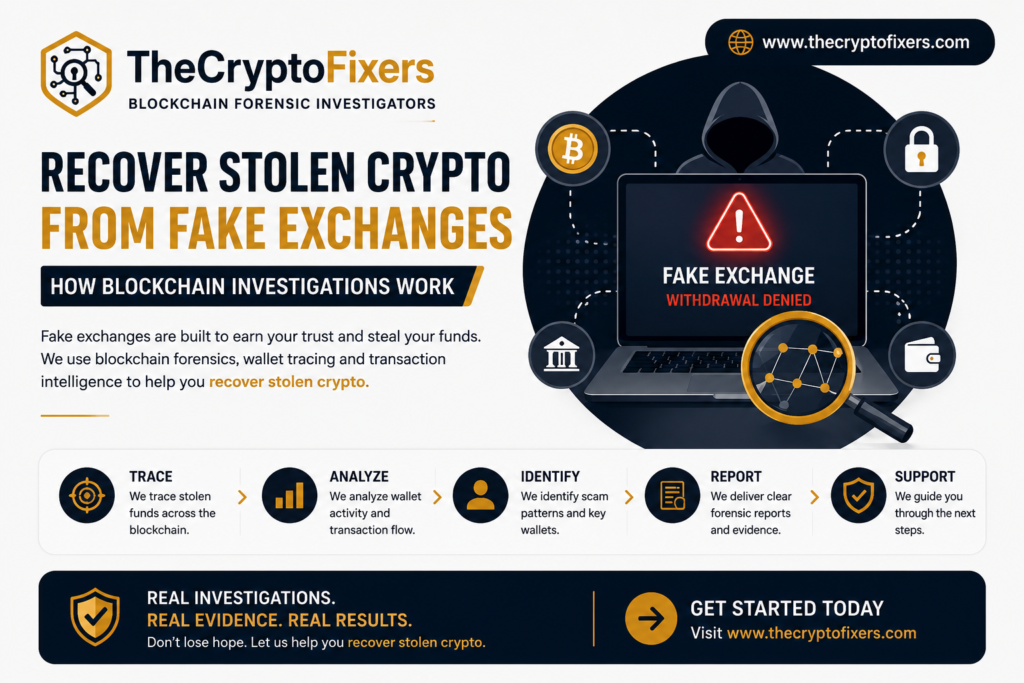
Learn how to recover stolen crypto from fake exchanges through blockchain forensic analysis, wallet tracing, and transaction intelligence. Discover how TheCryptoFixers investigates scam-related cryptocurrency movement.
Learn how to recover stolen crypto from fake exchanges through blockchain forensic analysis, wallet tracing, and transaction intelligence. Discover how TheCryptoFixers investigates scam-related cryptocurrency movement.
Cryptocurrency has transformed modern finance by enabling decentralized transactions, borderless payments, and digital asset ownership without traditional banking systems. However, as cryptocurrency adoption continues growing globally, fake exchanges and fraudulent investment platforms have become one of the most dangerous threats facing crypto users today.
Every day, victims search online to recover stolen crypto after transferring digital assets into fake cryptocurrency exchanges that appeared legitimate on the surface but were actually sophisticated scam operations designed to steal funds.
Victims often describe similar experiences:
- professional-looking trading platforms,
- fake account balances,
- simulated profits,
- manipulated dashboards,
- blocked withdrawals,
- sudden account restrictions,
- disappearing customer support,
- irreversible cryptocurrency transfers.
Unlike ordinary scams, fake exchange operations are often highly organized and technically sophisticated. Many mimic legitimate crypto trading platforms so convincingly that even experienced investors can become victims.
At TheCryptoFixers, blockchain forensic investigators focus on transaction tracing, wallet analysis, blockchain intelligence, and evidence-based cryptocurrency investigations designed to help victims understand how stolen funds move through blockchain ecosystems after fake exchange scams occur.
This guide explains:
- how fake crypto exchanges operate,
- how victims lose cryptocurrency,
- how blockchain investigations work,
- how digital asset tracing helps recover stolen crypto,
- why timing matters,
- and how blockchain forensic analysis supports crypto investigations.
What Is a Fake Crypto Exchange?
A fake crypto exchange is a fraudulent platform pretending to offer cryptocurrency trading, investing, or asset management services while secretly stealing user funds.
These scam exchanges often imitate:
- legitimate trading platforms,
- crypto investment dashboards,
- decentralized applications,
- professional exchange interfaces.
Victims attempting to recover stolen crypto frequently discover that:
- no real trading occurred,
- account balances were fabricated,
- profits were simulated,
- withdrawals were intentionally blocked,
- customer support vanished,
- cryptocurrency was laundered rapidly after deposits were made.
Why Fake Exchanges Are Increasing
Several factors have contributed to the rapid growth of fake crypto exchanges:
- increasing cryptocurrency adoption,
- global online investing,
- lack of blockchain knowledge,
- decentralized financial systems,
- irreversible transactions,
- anonymous wallet structures.
Scammers understand that many new crypto users are unfamiliar with:
- wallet security,
- blockchain tracing,
- transaction analysis,
- exchange verification.
As a result, fake exchange scams continue expanding globally.
Common Types of Fake Crypto Exchanges
Victims searching to recover stolen crypto often encounter several categories of fraudulent exchange scams.
1. Fake Investment Platforms
These platforms promise:
- guaranteed returns,
- AI trading systems,
- exclusive opportunities,
- automated profits.
Users see fake profits displayed while scammers encourage larger deposits.
2. Romance Scam Exchanges
Scammers build emotional relationships before introducing victims to fraudulent crypto exchanges.
Victims attempting to recover stolen crypto from romance scams often realize later that:
- the exchange was fake,
- the relationship was fabricated,
- the investment dashboard was manipulated.
3. Pig Butchering Scam Platforms
These operations involve long-term manipulation designed to maximize deposits before stealing funds.
Fake exchanges used in pig butchering scams often appear extremely sophisticated.
4. Clone Exchanges
Scammers create websites resembling legitimate exchanges.
They copy:
- logos,
- interfaces,
- charts,
- trading tools,
- branding.
Victims may believe they are using a real exchange.
5. Fake DeFi Platforms
Some scams imitate decentralized finance applications offering:
- staking,
- liquidity pools,
- yield farming,
- token investments.
Funds are routed directly into scam-controlled wallets.
How Victims Lose Cryptocurrency on Fake Exchanges
The process often follows predictable patterns.
Stage 1: Initial Contact
Victims are approached through:
- social media,
- WhatsApp,
- Telegram,
- dating apps,
- online advertisements,
- investment groups.
Stage 2: Trust Building
Scammers establish credibility through:
- fake testimonials,
- professional websites,
- fabricated success stories,
- fake customer support,
- manipulated trading dashboards.
Stage 3: Initial Deposit
Victims transfer cryptocurrency into the fake exchange platform.
Initially:
- balances appear real,
- profits are displayed,
- withdrawals may succeed temporarily.
This builds trust.
Stage 4: Larger Deposits
Scammers encourage victims to:
- invest more,
- increase leverage,
- unlock bonuses,
- participate in “exclusive” opportunities.
Victims searching later to recover stolen crypto often lost funds across multiple transactions.
Stage 5: Withdrawal Restrictions
When victims attempt withdrawals, scammers demand:
- taxes,
- unlocking fees,
- liquidity verification,
- account upgrades,
- anti-money laundering fees.
These payments are designed to steal additional funds.
Stage 6: Disappearance
Eventually:
- communication stops,
- accounts are blocked,
- websites disappear,
- customer support vanishes,
- funds move across laundering networks.
Victims then begin searching online to recover stolen crypto.
Why Recovering Stolen Crypto Is Difficult
Recovering stolen crypto from fake exchanges is often complicated because scammers move funds rapidly after receiving deposits.
Cryptocurrency transactions are:
- irreversible,
- decentralized,
- borderless,
- globally accessible.
Scammers frequently use:
- cross-chain bridges,
- mixers,
- decentralized exchanges,
- wallet fragmentation,
- stablecoin conversions,
- privacy tools.
These laundering methods complicate blockchain investigations significantly.
Why Blockchain Transparency Still Matters
Despite these challenges, blockchain transparency provides important investigative opportunities.
Most blockchain networks permanently record:
- transaction histories,
- wallet movement,
- timestamps,
- asset transfers,
- smart contract interactions.
This allows blockchain forensic investigators to:
- trace stolen cryptocurrency,
- analyze wallet behavior,
- identify suspicious movement,
- detect laundering patterns,
- investigate exchange exposure.
At TheCrypt oFixers, blockchain forensic investigations focus on structured transaction analysis and digital asset tracing methodologies designed to analyze suspicious cryptocurrency movement professionally and transparently.
How Blockchain Investigations Work
Step 1: Evidence Collection
The first step to recover stolen crypto involves gathering evidence.
Important evidence includes:
- wallet addresses,
- transaction hashes,
- screenshots,
- exchange communications,
- emails,
- platform URLs,
- payment records,
- chat logs.
Preserving evidence early improves investigative visibility significantly.
Step 2: Transaction Mapping
Blockchain forensic investigators analyze how cryptocurrency moved after leaving the victim’s wallet.
This process involves:
- identifying source wallets,
- tracking destination addresses,
- analyzing intermediary wallets,
- reviewing timestamps,
- mapping transaction flow.
The objective is to reconstruct how stolen cryptocurrency moved through blockchain systems.
Step 3: Wallet Clustering Analysis
Scammers rarely use only one wallet.
Investigators analyze wallet behavior to determine whether multiple addresses may belong to related entities.
Behavioral indicators include:
- transaction timing,
- movement structure,
- withdrawal behavior,
- asset conversion patterns,
- exchange interactions.
Wallet clustering helps investigators understand laundering structures more clearly.
Step 4: Exchange Exposure Identification
One important objective when attempting to recover stolen crypto is identifying interactions with centralized exchanges.
Regulated exchanges may maintain:
- KYC records,
- login histories,
- IP addresses,
- withdrawal data,
- compliance records.
If stolen cryptocurrency interacts with regulated exchanges, investigative opportunities may improve.
Step 5: Cross-Chain Investigation
Modern laundering networks frequently move assets across multiple blockchains.
Examples include:
- Bitcoin,
- Ethereum,
- Tron,
- Solana,
- BNB Chain,
- Polygon,
- Avalanche.
Cross-chain tracing helps investigators reconstruct fragmented movement patterns.
Why Scammers Use Wallet Fragmentation
Wallet fragmentation is commonly used to complicate efforts to recover stolen crypto.
Scammers split funds across:
- dozens,
- hundreds,
- or thousands
of smaller wallets.
This creates:
- transaction noise,
- investigative complexity,
- fragmented movement patterns.
Blockchain forensic investigators analyze:
- transaction sequencing,
- behavioral consistency,
- timing patterns,
- wallet relationships.
How Mixers Complicate Blockchain Tracing
Cryptocurrency mixers pool assets from multiple users before redistributing them.
This disrupts direct transactional visibility.
Investigators may still analyze:
- timing correlations,
- movement structures,
- transaction sequencing,
- behavioral indicators.
However, sophisticated mixing activity significantly increases tracing difficulty.
The Role of Decentralized Exchanges in Laundering
Scammers often use decentralized exchanges because they:
- require limited identification,
- support rapid token swaps,
- enable fast cross-chain movement.
DEX activity complicates efforts to recover stolen crypto because funds can move rapidly across multiple ecosystems.
Why Timing Matters in Crypto Investigations
Time is one of the most important factors in blockchain investigations.
Early investigations may improve:
- evidence preservation,
- exchange exposure analysis,
- transaction visibility,
- laundering detection.
Delayed investigations increase the likelihood that funds:
- move across chains,
- enter mixers,
- fragment across wallets,
- disappear into privacy ecosystems.
Victims should preserve evidence immediately after discovering suspicious activity.
What Victims Should Do Immediately
1. Stop Sending More Cryptocurrency
Fake exchanges frequently demand:
- withdrawal fees,
- verification payments,
- taxes,
- unlocking fees.
These are usually additional scam attempts.
2. Preserve Evidence
Save:
- transaction hashes,
- wallet addresses,
- screenshots,
- emails,
- chat logs,
- exchange communications.
3. Document the Timeline
Create a detailed chronology including:
- initial contact,
- deposits,
- withdrawal attempts,
- customer support interactions,
- payment requests.
4. Seek Blockchain Forensic Analysis
Professional blockchain investigations may help analyze:
- wallet movement,
- exchange exposure,
- laundering patterns,
- suspicious blockchain activity.
Why Fake Recovery Services Are Dangerous
Victims searching online to recover stolen crypto are often targeted again by fraudulent recovery services.
These scams commonly promise:
- guaranteed recovery,
- wallet hacking,
- instant blockchain reversals,
- secret recovery methods.
Legitimate blockchain forensic investigators do not make these claims.
Professional investigations focus on:
- transaction tracing,
- evidence analysis,
- wallet intelligence,
- forensic methodology.
Common Red Flags of Fake Recovery Services
Victims attempting to recover stolen crypto should remain cautious of:
- guaranteed recovery promises,
- anonymous operators,
- large upfront crypto payments,
- fake testimonials,
- pressure tactics,
- unrealistic timelines.
Professional blockchain forensic investigators explain:
- investigative limitations,
- uncertainty,
- possible outcomes,
- analytical processes.
Why Blockchain Forensics Matter
Blockchain forensics provide visibility into cryptocurrency movement.
Even when recovery is difficult, forensic analysis may help:
- identify suspicious wallets,
- document laundering structures,
- detect exchange exposure,
- reconstruct transaction pathways.
Digital asset tracing plays an increasingly important role in modern crypto investigations.
The Role of Human Analysis in Blockchain Investigations
Blockchain analytics software alone does not solve investigations.
Human investigators interpret:
- wallet behavior,
- transaction intent,
- laundering methodologies,
- timing anomalies,
- movement structures.
Experienced blockchain forensic investigators combine:
- analytical reasoning,
- blockchain intelligence,
- transaction analysis,
- investigative methodology.
Why Education Is Critical
Education helps reduce future victimization.
Understanding:
- fake exchange tactics,
- blockchain tracing,
- wallet behavior,
- scam methodologies,
- laundering structures
helps crypto users identify suspicious activity earlier.
How Organized Fake Exchange Networks Operate
Many fake exchanges are operated by organized scam groups.
These operations may involve:
- social engineering teams,
- fake customer support,
- technical developers,
- laundering specialists,
- marketing infrastructure.
Some networks operate internationally across multiple jurisdictions.
Why Blockchain Investigations Continue Growing
As cryptocurrency adoption expands globally, demand for:
- blockchain tracing,
- forensic analysis,
- transaction intelligence,
- digital asset investigations,
- scam analysis
continues increasing rapidly.
Victims searching online to recover stolen crypto are increasingly seeking:
- blockchain forensic investigators,
- transaction tracing experts,
- wallet analysis specialists.
The Future of Blockchain Forensic Investigations
Blockchain investigations continue evolving rapidly.
Emerging technologies include:
- AI-assisted transaction analysis,
- enhanced wallet clustering,
- behavioral analytics,
- cross-chain intelligence systems,
- DeFi forensic tools,
- advanced transaction visualization.
At the same time, scammers continue developing more sophisticated laundering strategies.
Why Victims Choose TheCryptoFixers
At TheCryptoFixers, blockchain forensic investigators focus on:
- transaction tracing,
- wallet analysis,
- scam-related blockchain investigations,
- digital asset intelligence,
- cross-chain analysis,
- forensic reporting support.
Services Include
- blockchain transaction tracing,
- wallet investigations,
- digital asset investigations,
- exchange exposure analysis,
- scam movement analysis,
- forensic reporting.
TheCryptoFixers Approach
- transparent methodology,
- evidence-based analysis,
- realistic investigative assessments,
- blockchain intelligence expertise,
- professional forensic investigation processes.
Final Thoughts
Fake crypto exchanges have become one of the most damaging forms of cryptocurrency fraud operating globally today.
These scams combine:
- sophisticated social engineering,
- fake investment platforms,
- manipulated dashboards,
- advanced laundering techniques,
- blockchain exploitation.
Victims attempting to recover stolen crypto often face emotionally and financially overwhelming situations.
Blockchain forensic investigations provide an important framework for understanding how stolen cryptocurrency moves through increasingly complex digital asset ecosystems.
At TheCryptoFixers, blockchain forensic investigations emphasize:
- transaction intelligence,
- wallet tracing,
- evidence-based analysis,
- professional methodology,
- realistic assessments.
As cryptocurrency adoption continues growing globally, blockchain forensic expertise and digital asset investigations will remain essential tools in analyzing suspicious crypto movement and understanding how modern fake exchange scams operate.