Learn the difference between a legitimate digital asset investigator and a fake crypto recovery service. Discover how TheCryptoFixers approaches blockchain forensic analysis and crypto tracing professionally.
The rapid growth of cryptocurrency adoption has created enormous opportunities for innovation, investment, and decentralized finance. Unfortunately, it has also created a massive rise in cryptocurrency scams, investment fraud, wallet thefts, phishing attacks, fake exchanges, social engineering operations, and fraudulent crypto recovery schemes.
Every day, thousands of victims search online to recover stolen crypto after losing digital assets through:
- fake investment platforms,
- romance scams,
- pig butchering scams,
- phishing attacks,
- wallet compromises,
- fake exchanges,
- impersonation fraud,
- social engineering scams.
When victims search online to recover stolen crypto, they often encounter another dangerous problem:
fake crypto recovery services.
Many scam victims are targeted a second time by fraudulent “recovery experts” who promise guaranteed recovery, secret hacking techniques, or instant access to stolen funds.
Understanding the difference between a legitimate digital asset investigator and a fake recovery service is essential for anyone attempting to recover stolen crypto safely and responsibly.
At TheCryptoFixers, digital asset investigators focus on blockchain forensic analysis, wallet tracing, transaction intelligence, and evidence-based cryptocurrency investigations designed to analyze suspicious blockchain activity professionally and transparently.
This guide explains:
- how fake recovery scams operate,
- what legitimate digital asset investigators actually do,
- how blockchain forensic investigations work,
- what realistic crypto tracing looks like,
- how victims can identify red flags,
- and why transparency matters when trying to recover stolen crypto.
Why Fake Crypto Recovery Services Are Increasing
The cryptocurrency recovery niche has become a major target for scammers because victims are often:
- emotionally distressed,
- financially desperate,
- unfamiliar with blockchain technology,
- urgently searching for solutions.
Scammers exploit this vulnerability aggressively.
Victims searching online to recover stolen crypto frequently encounter:
- fake investigators,
- fraudulent “ethical hackers,”
- fake blockchain experts,
- impersonation accounts,
- recovery scammers,
- fabricated testimonials,
- unrealistic promises.
These operations are designed to exploit victims emotionally after the initial scam already occurred.
Why Recover Stolen Crypto Searches Attract Scammers
The keyword “recover stolen crypto” carries extremely high emotional and commercial intent.
Victims searching this phrase are often:
- desperate for help,
- emotionally overwhelmed,
- unfamiliar with blockchain systems,
- vulnerable to manipulation.
Fake recovery scammers understand this.
They often create websites designed specifically to target victims searching:
- recover stolen crypto,
- crypto recovery service,
- recover lost Bitcoin,
- blockchain recovery expert,
- crypto tracing expert.
Many fake recovery operations use:
- aggressive promises,
- fake urgency,
- fabricated reviews,
- unrealistic guarantees.
What Is a Fake Recovery Service?
A fake recovery service is a fraudulent operation pretending to recover stolen cryptocurrency while actually exploiting victims for additional money or information.
These scams frequently claim they can:
- hack wallets,
- reverse blockchain transactions,
- recover crypto instantly,
- bypass blockchain systems,
- access private exchange databases,
- retrieve funds secretly.
In reality, many fake recovery services simply:
- collect upfront payments,
- disappear,
- request more fees repeatedly,
- steal personal information,
- conduct secondary fraud.
Victims trying to recover stolen crypto often lose additional funds to these operations.
What Is a Digital Asset Investigator?
A digital asset investigator specializes in blockchain forensic analysis and cryptocurrency transaction intelligence.
Unlike fake recovery services, legitimate digital asset investigators focus on:
- blockchain tracing,
- wallet analysis,
- transaction mapping,
- forensic documentation,
- scam analysis,
- exchange exposure identification,
- evidence-based investigations.
At TheCryptoFixers, digital asset investigators approach cryptocurrency investigations through structured blockchain forensic methodologies rather than unrealistic recovery guarantees.
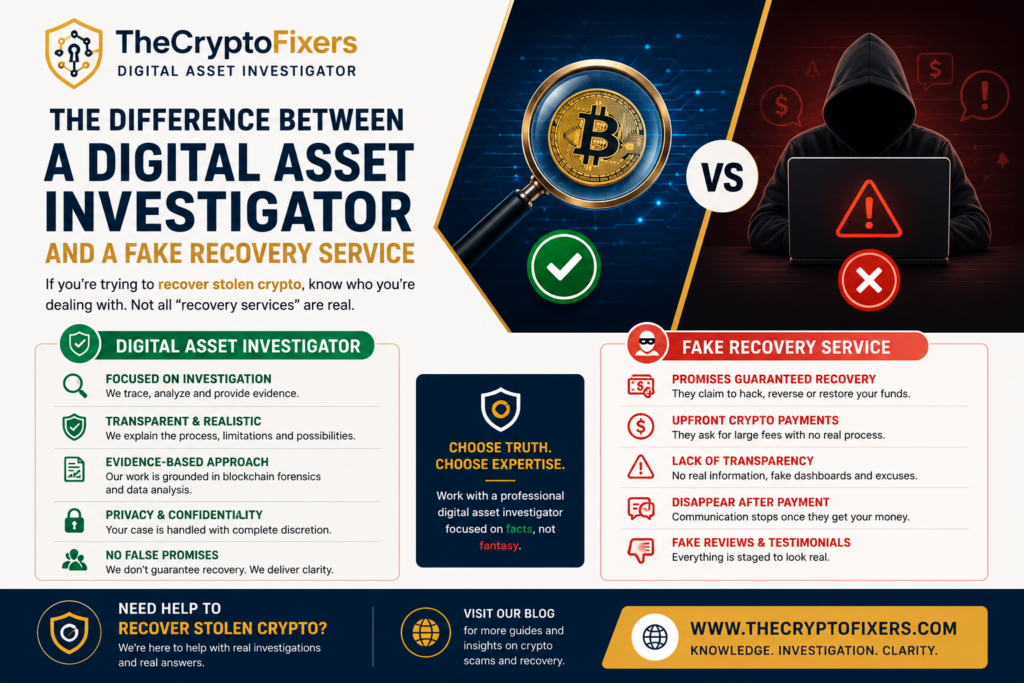
The Core Difference Between Legitimate Investigators and Fake Recovery Services
The biggest difference is simple:
Fake Recovery Services Sell False Guarantees
Digital Asset Investigators Conduct Evidence-Based Analysis
Legitimate investigators understand that blockchain investigations are:
- analytical,
- technical,
- evidence-driven,
- dependent on blockchain visibility,
- affected by laundering techniques,
- influenced by jurisdictional limitations.
Fake recovery services ignore these realities entirely.
How Fake Recovery Services Manipulate Victims
Fake recovery scams often follow predictable psychological patterns.
1. Guaranteed Recovery Claims
This is one of the biggest red flags.
No ethical investigator can guarantee recovery because cryptocurrency investigations depend on:
- blockchain movement,
- exchange cooperation,
- timing,
- evidence,
- jurisdiction,
- laundering activity.
Victims searching to recover stolen crypto should remain cautious of anyone promising:
- guaranteed results,
- instant recovery,
- 100% success rates.
2. “We Can Hack the Wallet” Claims
Legitimate digital asset investigators do not promise illegal hacking services.
Blockchain investigations focus on:
- tracing,
- analysis,
- transaction intelligence,
- forensic evidence.
Claims about:
- hacking wallets,
- reversing blockchain transactions,
- “unlocking” stolen crypto
are major warning signs.
3. Upfront Cryptocurrency Demands
Many fake recovery services demand large upfront payments in cryptocurrency.
After payment:
- communication slows,
- new fees appear,
- excuses increase,
- victims are pressured repeatedly.
This often becomes a second scam.
4. Fake Blockchain Screenshots
Fraudulent recovery operations frequently send:
- fake dashboards,
- manipulated blockchain screenshots,
- fabricated wallet balances,
- fake recovery progress reports.
These visuals are designed to convince victims that recovery is happening.
5. Emotional Pressure Tactics
Fake recovery scammers exploit urgency aggressively.
They may claim:
- “Funds will disappear soon,”
- “You must act immediately,”
- “Recovery closes today.”
Professional investigators focus on:
- evidence,
- transparency,
- investigative methodology.
Why Blockchain Transactions Cannot Simply Be Reversed
One of the biggest misconceptions among victims attempting to recover stolen crypto is the belief that blockchain transactions can simply be reversed.
Most public blockchain systems are intentionally designed to be:
- immutable,
- decentralized,
- irreversible.
Once confirmed, transactions generally cannot be undone.
This is why legitimate digital asset investigators focus on:
- tracing movement,
- identifying suspicious wallets,
- analyzing exchange exposure,
- documenting forensic evidence.
How Legitimate Blockchain Investigations Work
Professional blockchain investigations involve structured forensic methodologies.
Step 1: Evidence Collection
Digital asset investigators gather:
- wallet addresses,
- transaction hashes,
- screenshots,
- exchange records,
- scam communication,
- payment histories.
Preserving evidence early improves investigative visibility.
Step 2: Blockchain Transaction Analysis
Investigators analyze:
- source wallets,
- destination wallets,
- transaction sequences,
- timestamps,
- asset movement,
- wallet interactions.
This helps reconstruct how stolen cryptocurrency moved through blockchain systems.
Step 3: Wallet Clustering
Scammers rarely use a single wallet.
Investigators analyze behavioral patterns to determine whether multiple addresses may belong to related entities.
Wallet clustering involves:
- timing analysis,
- movement sequencing,
- withdrawal structures,
- address reuse,
- transaction behavior.
Step 4: Exchange Exposure Identification
One major objective when attempting to recover stolen crypto is identifying interactions with centralized exchanges.
Regulated exchanges may maintain:
- KYC records,
- IP logs,
- withdrawal histories,
- account information,
- compliance records.
If stolen funds interact with exchanges, investigative opportunities may improve.
Step 5: Cross-Chain Investigation
Modern laundering networks frequently move assets across multiple blockchain ecosystems.
Examples include:
- Bitcoin,
- Ethereum,
- Tron,
- Solana,
- Polygon,
- BNB Chain.
Cross-chain tracing helps investigators reconstruct fragmented transaction paths.
Why Laundering Techniques Complicate Efforts to Recover Stolen Crypto
Sophisticated scam operations use numerous laundering techniques designed to disrupt tracing.
Common examples include:
- mixers,
- decentralized exchanges,
- chain hopping,
- wallet fragmentation,
- privacy tools,
- stablecoin conversions.
These methods increase investigative complexity significantly.
Why Transparency Matters in Blockchain Investigations
Legitimate digital asset investigators explain:
- limitations,
- risks,
- investigative uncertainty,
- possible outcomes,
- forensic methodologies.
Fake recovery services avoid transparency because their business model depends on unrealistic promises.
Victims attempting to recover stolen crypto should value transparency over exaggerated claims.
The Role of Blockchain Analytics
Modern digital asset investigations often rely on blockchain analytics platforms capable of:
- transaction visualization,
- wallet attribution,
- exchange identification,
- suspicious activity detection,
- transaction graphing.
However, software alone does not solve investigations.
Human analysis remains essential.
Digital asset investigators interpret:
- behavioral patterns,
- laundering structures,
- timing anomalies,
- wallet interactions,
- blockchain intelligence.
Common Signs of a Legitimate Digital Asset Investigator
Victims searching online to recover stolen crypto should look for investigators who:
- explain limitations clearly,
- avoid guarantees,
- focus on forensic analysis,
- discuss blockchain tracing realistically,
- provide transparent methodology,
- emphasize evidence collection,
- avoid illegal claims.
At TheCryptoFixers, blockchain forensic investigations prioritize:
- transparency,
- transaction intelligence,
- evidence-focused analysis,
- realistic investigative assessments.
Why Fake Testimonials Are Common in Recovery Scams
Many fake recovery services publish:
- fabricated reviews,
- fake screenshots,
- manipulated balances,
- stock photographs,
- invented case studies.
Because victims are emotionally vulnerable, these tactics can appear convincing.
Victims attempting to recover stolen crypto should verify:
- company presence,
- transparency,
- consistency,
- professional communication,
- investigative credibility.
Why Timing Matters in Crypto Investigations
Time is one of the most important factors in blockchain tracing.
Early investigations may help:
- preserve evidence,
- identify exchange exposure,
- analyze movement patterns,
- document laundering behavior.
Delayed action increases the likelihood that funds:
- become fragmented,
- move across chains,
- enter mixers,
- disappear into privacy ecosystems.
Why Victims Become Targets Twice
Many victims searching to recover stolen crypto are emotionally vulnerable after losing funds initially.
Fake recovery services exploit:
- desperation,
- urgency,
- confusion,
- emotional trauma.
This creates “double victimization.”
Understanding this risk is essential for avoiding secondary scams.
What Victims Should Do After Losing Cryptocurrency
1. Stop Sending More Funds
Never continue sending cryptocurrency based on:
- promises,
- unlocking fees,
- tax claims,
- verification payments.
2. Preserve Evidence
Save:
- wallet addresses,
- transaction hashes,
- screenshots,
- emails,
- chat conversations,
- payment records.
3. Create a Timeline
Document:
- initial contact,
- transfers,
- platform activity,
- withdrawal attempts,
- communication history.
4. Seek Professional Blockchain Analysis
Structured blockchain investigations may help analyze:
- transaction movement,
- exchange exposure,
- laundering behavior,
- suspicious wallet activity.
Why Education Is Critical
Education helps reduce future victimization.
Victims who understand:
- blockchain tracing,
- scam methodologies,
- wallet behavior,
- social engineering,
- laundering techniques
are less likely to fall for fake recovery schemes.
The Role of Digital Asset Investigators in Modern Crypto Fraud Cases
Digital asset investigators play an increasingly important role in:
- blockchain analysis,
- transaction intelligence,
- scam investigations,
- wallet tracing,
- forensic documentation,
- exchange exposure analysis.
As cryptocurrency fraud increases globally, demand for blockchain forensic expertise continues growing rapidly.
Why Recover Stolen Crypto Searches Continue Growing
As more individuals enter cryptocurrency markets, exposure to fraud also increases.
Victims continue searching online to recover stolen crypto after experiencing:
- fake exchange scams,
- romance scams,
- pig butchering scams,
- phishing attacks,
- wallet compromises,
- impersonation fraud.
This creates increasing demand for:
- blockchain tracing,
- digital asset investigations,
- forensic analysis,
- transaction intelligence.
Why TheCryptoFixers Emphasizes Blockchain Forensics
At TheCryptoFixers, the investigative focus remains on:
- blockchain forensic analysis,
- transaction tracing,
- wallet intelligence,
- evidence-based methodology,
- scam-related blockchain investigations.
The objective is to provide:
- realistic assessments,
- transparent analysis,
- professional forensic support,
- structured blockchain intelligence.
The Future of Blockchain Investigations
Blockchain investigations continue evolving rapidly as:
- cryptocurrency adoption expands,
- scam operations become more sophisticated,
- laundering techniques evolve,
- cross-chain ecosystems grow.
Emerging forensic technologies include:
- AI-assisted blockchain analysis,
- enhanced wallet clustering,
- DeFi transaction analytics,
- behavioral risk intelligence,
- advanced transaction visualization.
At the same time, fake recovery scams will likely continue targeting victims searching online to recover stolen crypto.
This makes public education increasingly important.
Why Victims Choose TheCryptoFixers
At TheCryptoFixers, digital asset investigators focus on:
- blockchain tracing,
- wallet analysis,
- scam-related transaction mapping,
- cross-chain investigation,
- forensic reporting support,
- evidence-based blockchain intelligence.
Services Include
- blockchain transaction tracing,
- wallet investigations,
- digital asset investigations,
- scam movement analysis,
- exchange exposure identification,
- forensic reporting.
TheCryptoFixers Approach
- transparent methodology,
- realistic expectations,
- evidence-focused analysis,
- blockchain forensic expertise,
- investigative integrity.
Final Thoughts
The cryptocurrency industry continues facing a growing wave of scams, fraud operations, and fake recovery schemes targeting vulnerable victims searching online to recover stolen crypto.
Understanding the difference between a legitimate digital asset investigator and a fake recovery service is essential for protecting victims from additional financial harm.
Fake recovery services rely on:
- emotional manipulation,
- unrealistic guarantees,
- fake hacking claims,
- fabricated evidence,
- pressure tactics.
Legitimate digital asset investigators focus on:
- blockchain forensic analysis,
- transaction tracing,
- wallet intelligence,
- evidence-based investigations,
- realistic assessments.
At TheCryptoFixers, blockchain forensic investigations emphasize transparency, professional methodology, and analytical blockchain intelligence designed to help victims better understand suspicious cryptocurrency movement within increasingly complex blockchain ecosystems.